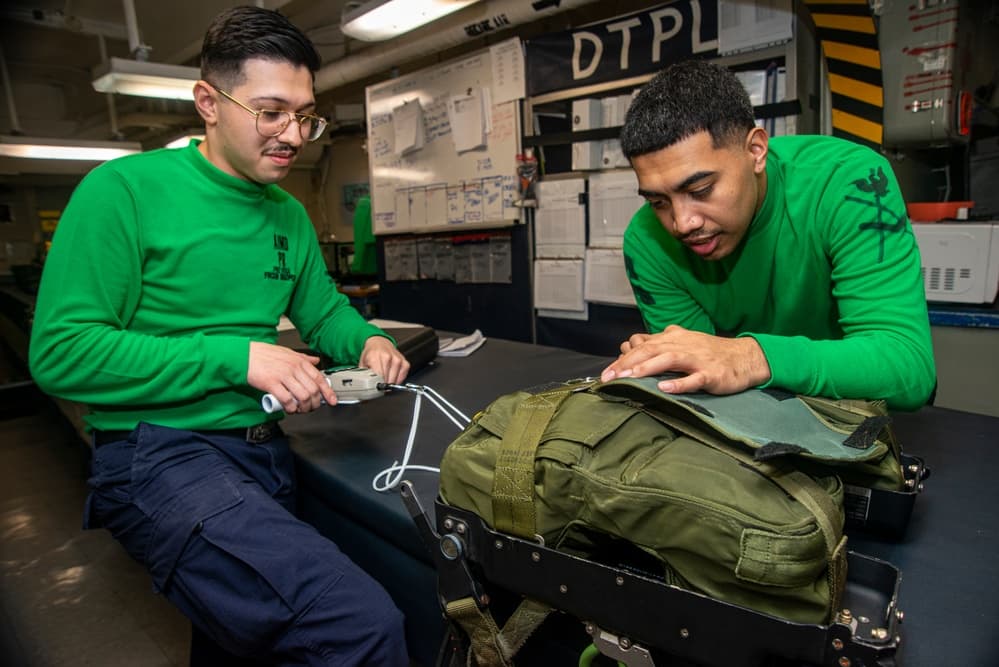
Aircrew Survival Equipmentman
Maintains parachutes, life rafts, and survival equipment for naval aviation.
Overall
Quick Stats
Security Clearance
None
This rate does not require a security clearance.
ASVAB Requirements
Who This Is Best For
Best for meticulous individuals who take safety personally and want to work in a specialized niche where perfection is the only standard. If you find satisfaction in knowing your precise work protects lives, this rate offers strong camaraderie in a small, respected community. Civilian transfer options are narrow but the work is deeply meaningful.
+Pros
- ✓Strong civilian career transition
–Cons
Real Opinions
+Positive
“PR is one of the most chill aviation rates. You maintain life-saving equipment and work mostly in a shop environment with normal hours.”
“Knowing that pilots trust your work with their lives gives you a real sense of purpose. The attention to detail this rate teaches you is invaluable.”
“I would recommend PR to anyone considering it. The training is solid and the community takes care of its own.”
–Critical & Mixed
“Advancement is slow because the community is small. You can be stuck at E-4 for a long time.”
“Like any rate, PR has its downsides. Long hours, time away from family, and Navy bureaucracy are real.”
“PR is a small, tight-knit community, but that also means limited advancement opportunities. You maintain survival equipment, parachutes, and ejection seat components — critical work, but the small community size means you could be the best PR in the Navy and still wait years for promotion. Civilian translation is narrow — not many parachute rigger jobs on the outside.”
Recruiter vs Reality
What the recruiter says vs. what it's actually like.
🫡 Recruiter says
“The PR rate offers great training and career advancement opportunities!”
💀 Reality
Source: MyNavyRates researchTraining and advancement are available but vary by command and manning. Ask specific questions about sea/shore rotation, typical duty stations, and advancement rates for PR.
🫡 Recruiter says
“PR is a small, tight-knit aviation rate.”
💀 Reality
Source: sailor forumsTrue, and the small size means limited advancement opportunities and fewer duty station options. Most PR billets are at air stations.
🫡 Recruiter says
“PR maintains parachutes and survival equipment.”
💀 Reality
Source: veteran feedbackPR inspects, maintains, and packs parachutes, life rafts, and survival vests. The work is meticulous and repetitive but the responsibility is critical. A poorly packed parachute kills someone.
🫡 Recruiter says
“You'll maintain the equipment that saves aircrew lives — parachutes, ejection seats, survival gear.”
💀 Reality
The responsibility is real — if a parachute fails because of your work, someone dies. But the daily reality is inspecting, repacking, and sewing survival gear on industrial sewing machines. The work is repetitive and detail-oriented, not adrenaline-fueled.
🫡 Recruiter says
“PR is a unique, specialized rate with a proud tradition going back to parachute riggers.”
💀 Reality
The tradition is real — PRs pack chutes and must do a periodic live jump with a parachute they packed themselves. But the rate is very small, meaning advancement to E-6+ is slow with few quotas per cycle.
🫡 Recruiter says
“You'll learn sewing, rigging, oxygen systems, and survival equipment maintenance — diverse skills.”
💀 Reality
The "Combat Sewing" portion uses industrial sewing machines, and yes, you will sew — a lot. You also maintain oxygen systems, anti-exposure suits, g-suits, NVDs, life rafts, and flotation devices. The skill set is niche — outside the military, the direct job market is very small.
🫡 Recruiter says
“PR is one of the best quality-of-life rates in aviation — you work in a clean shop environment.”
💀 Reality
The Paraloft is generally cleaner than a hangar. But PR shops are small — often 4-8 people. When someone goes TAD or on leave, the remaining PRs absorb the entire workload. Pre-deployment gear inspections can mean 14-hour days for weeks.
🫡 Recruiter says
“Your skills will transfer to civilian aviation safety and survival equipment companies.”
💀 Reality
The direct civilian market for parachute riggers is small — primarily skydiving operations, military contractors, and a few aerospace companies. Most PRs pivot to broader fields using QA, inspection, and safety management experience.
🫡 Recruiter says
“PR A-school is 12 weeks in Pensacola — you'll be a qualified survival equipment technician.”
💀 Reality
A-school is hands-on — you learn parachute packing, sewing, oxygen systems, and survival equipment inspection. But at your first command, you are the most junior person in a very small shop where every senior PR has been doing this for years. The stakes are high and the senior PRs will make sure you know it.
Training Pipeline — Total ~16 weeks (4 months)
Ship Date Calculator
Enter your MEPS ship date to see when you'll complete each stage.
Promotion SpeedEarn higher pay fasterAverageManning 79%
| Cycle (Year) | Eligible | Selected | Promotion % |
|---|---|---|---|
| E-4252-Spring(2024) | 62 | 56 | 90% |
| E-4252-Fall(2024) | 158 | 69 | 44% |
| E-5252-Spring(2024) | 188 | 49 | 26% |
| E-5252-Fall(2024) | 184 | 60 | 33% |
| E-6252-Spring(2024) | 74 | 24 | 32% |
| E-6252-Fall(2024) | 30 | 26 | 87% |
Bonuses — Click here to see your military pay
Enlistment Bonus
No active bonus for this rate
You May Qualify for a Navy Enlisted Classification (NEC)
Specialties within this rate you can select, some with additional compensation. Each NEC has its own training, bonus potential, and career path.
Primary specialty code for Aircrew Survival Equipmentman rating
Advanced specialty code for experienced Aircrew Survival Equipmentman personnel
Potential Civilian Post-Navy Outcomes
Parachute Rigger
Transferability: 5/10
$38k–$55k
Lifestyle5/10
Ship vs. Shore Split
55% / 45%
Deployment Frequency
Moderate
Physical Demand
medium — indoor
Watch Standing
Flight schedule dependent, rotating duty days
Watch standing is a 24-hour duty rotation where sailors take turns manning critical positions aboard the ship or at their command. The rotation determines how frequently you stand watch and how much rest time you get between shifts.
Watch qualifications vary by command and platform. Expect to qualify within 90 days of reporting.
Common Duty Stations
—
Schools + spouse jobs
—
Avg waitlist for on-base
95
100 = national avg
—
Schools + spouse jobs
—
Avg waitlist for on-base
135
100 = national avg
—
Schools + spouse jobs
—
Avg waitlist for on-base
92
100 = national avg