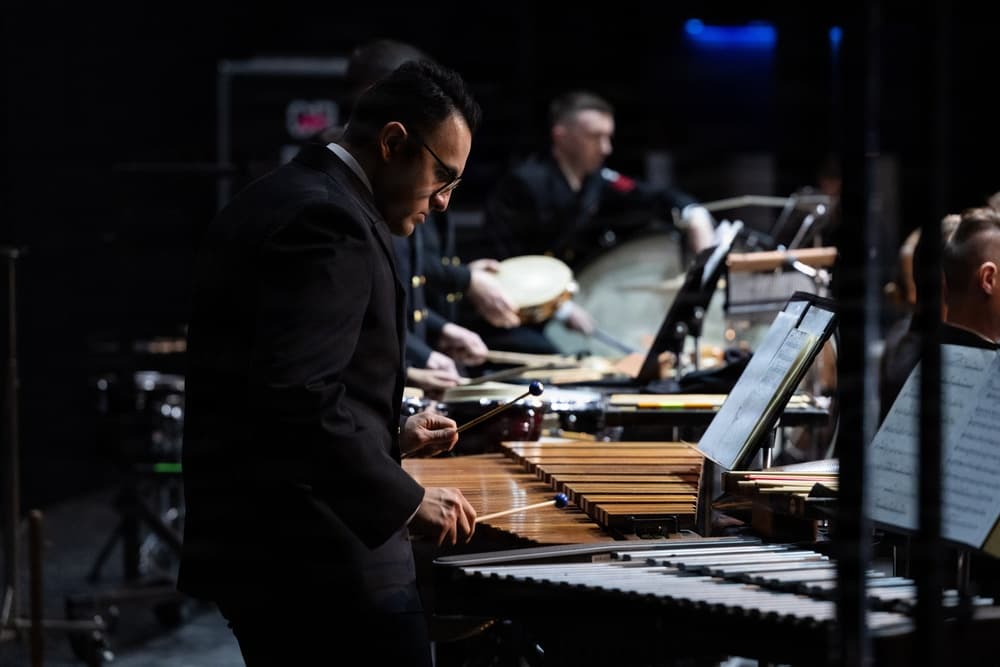
Musician
Performs in Navy bands at official ceremonies, concerts, and community outreach events. Requires musical audition.
Overall
Quick Stats
Security Clearance
None
This rate does not require a security clearance.
ASVAB Requirements
AFQT Minimum
31
Who This Is Best For
Best for talented musicians who want steady pay, travel, and professional performance opportunities while serving. Requires a successful audition — this is for skilled instrumentalists or vocalists who want to maintain their artistic craft within a military framework. One of the rarest and most unique enlisted career paths.
+Pros
- ✓Strong civilian career transition
–Cons
Real Opinions
+Positive
“MUs are incredibly talented in a lot of instances. A lot of them come in with deals to make rank fast.”
“I would recommend MU to anyone considering it. The training is solid and the community takes care of its own.”
“Outstanding opportunity to serve my country with lots of travel and great pay the longer you are enlisted. The Naval School of Music was outstanding. You get to perform everything from presidential inaugurations to parades in Paris. It is highly unlikely an MU will spend any time at sea.”
–Critical & Mixed
“In the Navy Bands just about everyone has either a BS in Education, a BA or BM in performance or a Masters. So the competition is tough.”
“Only zero to two people promoted per cycle out of 75 to 100 testing. Advancement is extremely slow.”
“Like any rate, MU has its downsides. Long hours, time away from family, and Navy bureaucracy are real.”
Recruiter vs Reality
What the recruiter says vs. what it's actually like.
🫡 Recruiter says
“The MU rate offers great training and career advancement opportunities!”
💀 Reality
Source: MyNavyRates researchTraining and advancement are available but vary by command and manning. Ask specific questions about sea/shore rotation, typical duty stations, and advancement rates for MU.
🫡 Recruiter says
“MU has the best quality of life in the Navy.”
💀 Reality
Source: sailor forumsMU is shore-based, regular hours, and genuinely enjoyable work. The trade-off is extremely slow advancement because the rate is tiny. There are very few MU billets in the entire Navy.
🫡 Recruiter says
“Navy Musicians travel and perform for audiences.”
💀 Reality
Source: veteran feedbackMU is competitive to enter and requires audition-level musical ability. Once in, you perform at ceremonies, concerts, and community events. The musical quality is professional-grade.
🫡 Recruiter says
“Navy Musicians travel the world performing for audiences.”
💀 Reality
Navy bands do perform at ceremonies, public events, and diplomatic functions. But most performances are change of command ceremonies, retirements, and base events — not concert tours. Travel exists but is command-directed.
🫡 Recruiter says
“MU is all shore duty — no deployments.”
💀 Reality
MU is genuinely one of the few all-shore-duty rates. However, Navy bands do deploy for morale tours and diplomatic missions. These are temporary, not extended deployments.
🫡 Recruiter says
“You enter as an E-2 or E-3 with your education.”
💀 Reality
MU requires a live audition, and competition is fierce. Many applicants have music degrees. You enter at E-2 or E-3 based on education, but advancement beyond that is extremely competitive in one of the smallest rates in the Navy.
🫡 Recruiter says
“MU is a great way to get paid to play music.”
💀 Reality
You get paid to play, but you also get paid to set up chairs, haul equipment, do admin work, and maintain instruments. Performance is only part of the job. Expect significant time on non-musical duties.
🫡 Recruiter says
“The Navy has world-class music programs.”
💀 Reality
Navy bands are genuinely excellent. But the style of music you play is dictated by the band's mission — patriotic, ceremonial, and popular music. If your passion is jazz or classical, you may not get to play what you love most of the time.
🫡 Recruiter says
“MU advancement is manageable in a small community.”
💀 Reality
Small community means very few advancement quotas each cycle. You may be the best musician in the Navy and still not promote because there are only a handful of E-6 or E-7 billets available in any given year.
Training Pipeline — Total ~20 weeks (5 months)
Ship Date Calculator
Enter your MEPS ship date to see when you'll complete each stage.
Promotion SpeedEarn higher pay faster—Manning 80% (E-5/E-6)
| Cycle (Year) | Eligible | Selected | Promotion % |
|---|---|---|---|
| E-4252-Spring(2024) | 191 | 27 | 14% |
| E-4252-Fall(2024) | 223 | 84 | 38% |
| E-5252-Spring(2024) | 140 | 60 | 43% |
| E-5252-Fall(2024) | 165 | 25 | 15% |
| E-6252-Spring(2024) | 146 | 28 | 19% |
| E-6252-Fall(2024) | 116 | 15 | 13% |
Bonuses — Click here to see your military pay
Enlistment Bonus
No active bonus for this rate
You May Qualify for a Navy Enlisted Classification (NEC)
Specialties within this rate you can select, some with additional compensation. Each NEC has its own training, bonus potential, and career path.
Primary specialty code for Musician rating
Advanced specialty code for experienced Musician personnel
Potential Civilian Post-Navy Outcomes
Professional Musician / Music Director
Transferability: 4/10
$30k–$60k
Lifestyle9/10
Ship vs. Shore Split
5% / 95%
Deployment Frequency
Low
Physical Demand
low — mixed
Watch Standing
Standard shore hours, CDO/DCPO rotation when assigned
Watch standing is a 24-hour duty rotation where sailors take turns manning critical positions aboard the ship or at their command. The rotation determines how frequently you stand watch and how much rest time you get between shifts.
Watch qualifications vary by command and platform. Expect to qualify within 90 days of reporting.