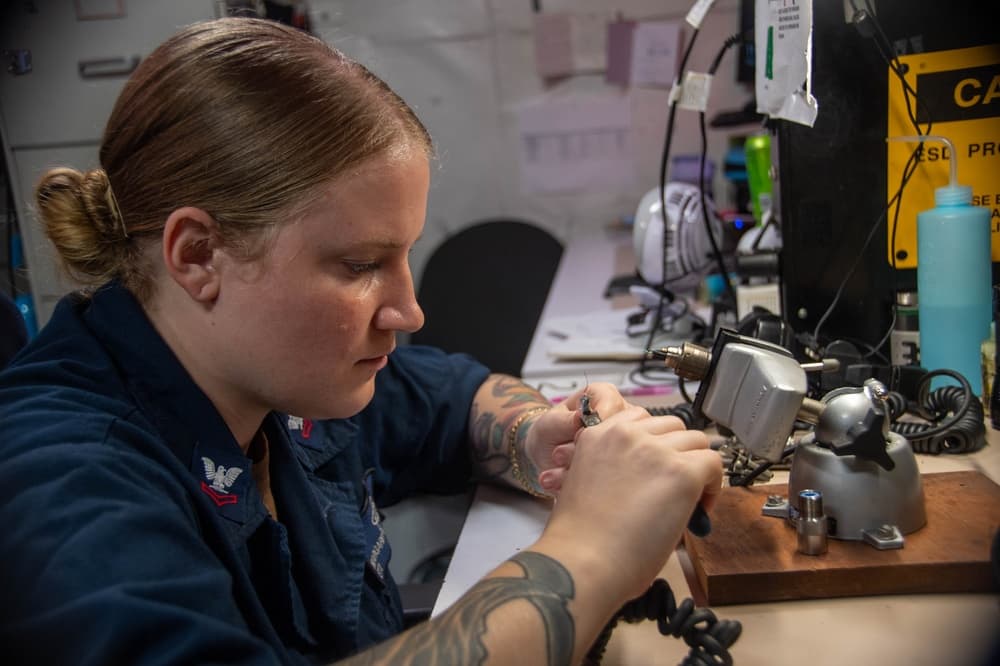
Electronics Technician
Electronics Technicians maintain and repair electronic equipment including radar, communications, navigation, and computer systems aboard ships, submarines, and shore stations.
Overall
Quick Stats
Security Clearance
Secret~$3K–$15K civilian sector value
Requires a National Agency Check with Local Agency Check and Credit Check (NACLC). Processing typically takes 1–3 months and is initiated early in your training pipeline.
ASVAB Requirements
Who This Is Best For
Best for detail-oriented tech enthusiasts who enjoy diagnosing complex electronic problems and want training that opens doors to telecom, IT, and defense industry jobs paying well into six figures. One of the deepest technical education paths in the Navy with strong civilian salary potential.
+Pros
- ✓Active enlistment bonus available
- ✓Strong civilian career transition
–Cons
- ✗Long A-school pipeline
- ✗Significant sea duty
Real Opinions
+Positive
“ET is a solid rate. You learn electronics repair and troubleshooting that applies everywhere in civilian world.”
“A-school is challenging but sets you up well. Great foundation for an engineering career.”
“Solid technical training that directly transfers to defense contractor jobs. The work can be tedious but the career payoff is worth it.”
“ETs who get out with their Security+ and a clearance are basically guaranteed a $80K+ job in the DC area.”
–Critical & Mixed
“Ship heavy but the work is interesting. You maintain and repair the most complex systems on the ship.”
“Underpaid, but you get free training and travel. Extremely micromanaged by leadership who also has no idea what they are doing. Commands can be clicky. Overmanning is severely hurting the advancement percentage from second to first class, creating a bottleneck for junior sailors.”
“ET is a solid choice if you want a technical, transferable rating with steady demand. But on surface ships, you're working 12-hour shifts 7 days a week at sea. The sheer number of ETs means advancement can be slow, especially E-5 to E-6 where the community gets crowded.”
Recruiter vs Reality
What the recruiter says vs. what it's actually like.
🫡 Recruiter says
“ETs work on the most advanced electronics in the military”
💀 Reality
Source: r/navyYou will troubleshoot and maintain systems, but a lot of it is swapping Line Replaceable Units — not designing circuits. Deeper technical work comes with seniority.
🫡 Recruiter says
“ETs work normal hours and have a chill lifestyle”
💀 Reality
Source: r/navyETs on shore duty work reasonable hours. ETs on a ship work around the clock when equipment breaks — and equipment always breaks. You're the one getting called at 2 AM because radar is down or comms are degraded. Expect to troubleshoot under pressure with leadership breathing down your neck.
🫡 Recruiter says
“ET sets you up for a six-figure civilian career.”
💀 Reality
Source: sailor forumsET skills are valuable but the highest-paying civilian jobs require additional certifications and often a degree. The Navy COOL program can help fund certs while you serve.
🫡 Recruiter says
“ET is the best electronics job in the Navy.”
💀 Reality
Source: veteran feedbackET is extremely broad. You could work on radars, communications, or navigation systems. What you actually work on depends entirely on your ship and division assignment. Some ETs never touch the equipment they trained on.
🫡 Recruiter says
“ETs work on AEGIS combat systems — the most advanced weapons technology.”
💀 Reality
Only ETs assigned to CG or DDG platforms work on AEGIS. Many ETs end up on amphibs, carriers, or shore commands maintaining completely different systems. You do not choose your equipment specialty.
🫡 Recruiter says
“ET A School gives you advanced electronics training you can't get anywhere else.”
💀 Reality
A School teaches fundamentals — Ohm's law, basic digital circuits, soldering. The real learning happens at C School and in the fleet. Many ETs spend their first year running PMS checks rather than doing deep troubleshooting.
🫡 Recruiter says
“ETs have the best quality of life among technical rates.”
💀 Reality
ETs generally avoid the worst engine room conditions, but you trade that for being perpetually on-call. Radar, comms, and navigation are mission-critical. If the CO cannot see anything on the scope, your division works until it is fixed — sleep schedule does not matter.
Training Pipeline — Total ~38 weeks (9 months)
Ship Date Calculator
Enter your MEPS ship date to see when you'll complete each stage.
Promotion SpeedEarn higher pay fasterAverageManning 84%
| Cycle (Year) | Eligible | Selected | Promotion % |
|---|---|---|---|
| E-4254(2025) | 220 | 150 | 68% |
| E-4253(2024) | 215 | 145 | 67% |
| E-5254(2025) | 250 | 82 | 33% |
| E-5253(2024) | 245 | 78 | 32% |
| E-6254(2025) | 140 | 35 | 25% |
| E-6253(2024) | 135 | 33 | 24% |
Bonuses — Click here to see your military pay
Enlistment Bonus
Bonus by Contract Length
6-Year Contract
$22,000
5-Year Contract
$16,500
4-Year Contract
$11,000
How to Qualify
- Sign a contract for this rate at MEPS — bonus eligibility is locked at the time of contract signing
- Ship to boot camp and successfully complete Recruit Training Command (RTC) at Great Lakes, IL
- Complete A-School and any required follow-on training in the ET pipeline
- Receive your rate assignment and report to your first duty station
- Bonus is typically paid in installments — 50% after completing training, remainder in anniversary payments
Important Details
- •Longer contracts receive higher bonus amounts
- •Bonus amounts are subject to federal income tax withholding (typically 22%)
- •If you fail to complete training or are separated early, you may be required to repay a prorated portion
- •Bonus availability and amounts change frequently based on Navy manning needs — confirm with your recruiter
- •This rate requires a security clearance — failure to obtain clearance may affect bonus eligibility
You May Qualify for a Navy Enlisted Classification (NEC)
Specialties within this rate you can select, some with additional compensation. Each NEC has its own training, bonus potential, and career path.
Maintains Aegis combat system computer networks
Advanced specialty code for experienced Electronics Technician personnel
Potential Civilian Post-Navy Outcomes
Electronics Technician
Transferability: 8.5/10
$55k–$95k
Telecom Technician
Transferability: 7.5/10
$50k–$80k
Free Certifications & Credentials
Certifications and licenses the Navy will pay for free through Navy COOL and on-the-job training.
CET (Certified Electronics Technician)
ETA International
FCC GROL
FCC
CompTIA A+
CompTIA
CompTIA Network+
CompTIA
Certified Electronics Technician
ETA International
Lifestyle6/10
Ship vs. Shore Split
60% / 40%
Deployment Frequency
Moderate
Physical Demand
low — indoor
Watch Standing
4-section in port, 3-section underway
In a 4-section rotation, the crew is divided into four teams. Each team stands a 6-hour watch shift, then has 18 hours off before their next watch. In port, you stand 24-hour duty roughly every 4 days — meaning you stay aboard the ship overnight on your duty day.
Radar/comm equipment monitoring; EKMS custodian rotations
Common Duty Stations
—
Schools + spouse jobs
—
Avg waitlist for on-base
95
100 = national avg
—
Schools + spouse jobs
—
Avg waitlist for on-base
135
100 = national avg
—
Schools + spouse jobs
—
Avg waitlist for on-base
92
100 = national avg