Electrician's Mate
Electrician's Mates operate and maintain electrical power generation and distribution systems aboard ships, submarines, and at shore facilities. EMs work with generators, motors, transformers, switchboards, and lighting systems.
Overall
Quick Stats
Security Clearance
Secret~$3K–$15K civilian sector value
Requires a National Agency Check with Local Agency Check and Credit Check (NACLC). Processing typically takes 1–3 months and is initiated early in your training pipeline.
ASVAB Requirements
Who This Is Best For
Best for hands-on problem solvers who enjoy electrical troubleshooting and want one of the most directly transferable trade skills in the fleet. Experience counts toward journeyman electrician licensure — meaning you leave the Navy with a credential most civilians spend years and thousands of dollars earning on their own.
+Pros
- ✓Active enlistment bonus available
- ✓Strong civilian career transition
–Cons
- ✗Significant sea duty
Real Opinions
+Positive
“Being an EM is easy as long as you pay attention, you are a good learner, and follow the rules as much as you can.”
“The Navy provided sailors with a disciplined life and a very useful trade that could be used in civilian life.”
“Electricians on a ship work hard but the skills translate directly. I got my journeyman card while in.”
“You leave the Navy as a qualified electrician. Most civilians pay tens of thousands for that same training.”
–Critical & Mixed
“Expect long hours in the engine room. It is hot, loud, and dirty but the camaraderie is unmatched.”
“Ship life dominates your career. Shore billets exist but they are hard to come by.”
“EM is a sea-intensive and technical rating. Sailors learn a lot about mechanical and electrical engineering but lose significant sleep and family time. There is lots of time away from home with minimal to no contact, a very high divorce rate, and leadership that is hit or miss.”
Recruiter vs Reality
What the recruiter says vs. what it's actually like.
🫡 Recruiter says
“You'll learn to run power plants — great for civilian power companies”
💀 Reality
Source: r/navy veteransThe skills are real, but shipboard electrical work is grueling. Expect long hours in hot engine rooms and port-and-starboard watches on deployment.
🫡 Recruiter says
“Engineering rates always have great advancement”
💀 Reality
Source: Navy advancement quotasEM advancement has been average at best recently. Manning fluctuates, and being undermanned means more work, not faster promotion.
🫡 Recruiter says
“You'll become a fully qualified electrician with skills that transfer directly to civilian jobs.”
💀 Reality
Navy work focuses on shipboard power — 450V switchboards and motor controllers. Civilian electrical work is mostly 120/240V residential or 480V commercial. You still need a journeyman license or state certification after you get out.
🫡 Recruiter says
“EMs work on high-tech electrical systems.”
💀 Reality
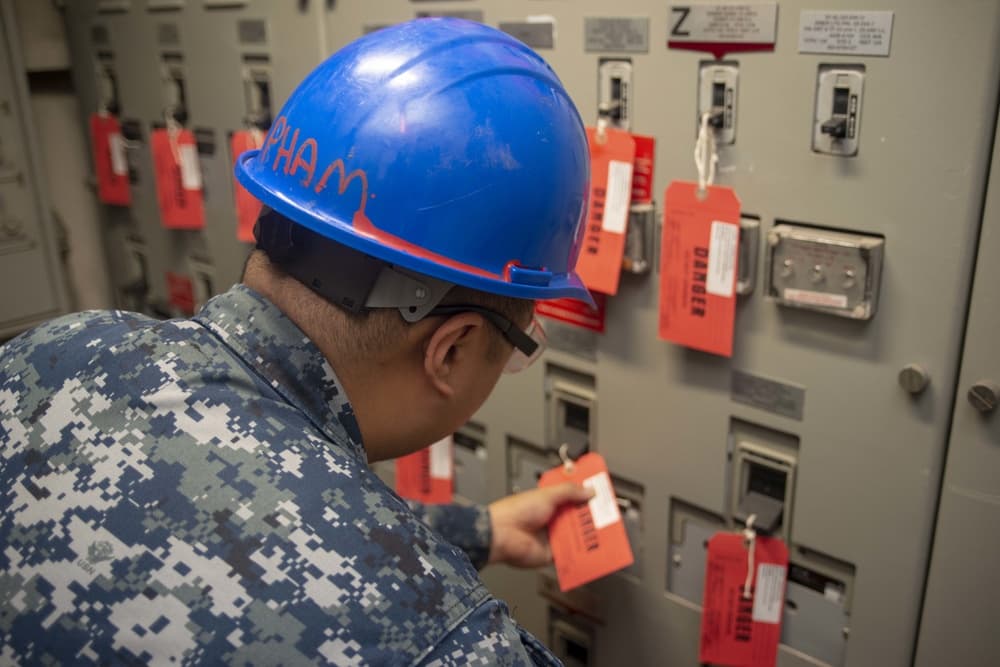
A large portion of the job is tag-out procedures — filling out paperwork to safely de-energize equipment before anyone touches it. Expect to become an expert in NAVSEA tag-out procedures. The paperwork rivals the wrench-turning.
🫡 Recruiter says
“EMs have a comfortable work environment compared to other engineering rates.”
💀 Reality
Your shop might be air-conditioned, but work takes you into hot engine rooms. You're tracing cables through bilges, working in switchboard rooms that hit 100+ degrees, and crawling behind panels in tight spaces.
🫡 Recruiter says
“EM gives you hands-on experience with power generation systems.”
💀 Reality
Standing electrical plant watch means monitoring gauges for hours and logging readings every 30 minutes. When something breaks, you're getting called at 0200 to troubleshoot why half the ship lost power.
🫡 Recruiter says
“Electrician's Mates have great advancement opportunities.”
💀 Reality
EM advancement is middle-of-the-pack for engineering rates. The rating is not tiny, so competition for E-5 and E-6 can be stiff. Your eval matters more than your technical knowledge for promotion.
🫡 Recruiter says
“Engineering rates are always in demand — the Navy needs EMs badly.”
💀 Reality
"In demand" means you will likely go to a ship for your first tour. Shore duty comes later. Expect 60-70% of your career at sea. The "in demand" part means more underway time, not a cushier assignment.
Training Pipeline — Total ~28 weeks (7 months)
Ship Date Calculator
Enter your MEPS ship date to see when you'll complete each stage.
Promotion SpeedEarn higher pay fasterAverageManning 88%
| Cycle (Year) | Eligible | Selected | Promotion % |
|---|---|---|---|
| E-4254(2025) | 190 | 120 | 63% |
| E-4253(2024) | 185 | 115 | 62% |
| E-5254(2025) | 180 | 56 | 31% |
| E-5253(2024) | 175 | 52 | 30% |
| E-6254(2025) | 110 | 22 | 20% |
| E-6253(2024) | 105 | 20 | 19% |
Bonuses — Click here to see your military pay
Enlistment Bonus
Bonus by Contract Length
6-Year Contract
$20,000
5-Year Contract
$15,000
4-Year Contract
$10,000
How to Qualify
- Sign a contract for this rate at MEPS — bonus eligibility is locked at the time of contract signing
- Ship to boot camp and successfully complete Recruit Training Command (RTC) at Great Lakes, IL
- Complete A-School and any required follow-on training in the EM pipeline
- Receive your rate assignment and report to your first duty station
- Bonus is typically paid in installments — 50% after completing training, remainder in anniversary payments
Important Details
- •Longer contracts receive higher bonus amounts
- •Bonus amounts are subject to federal income tax withholding (typically 22%)
- •If you fail to complete training or are separated early, you may be required to repay a prorated portion
- •Bonus availability and amounts change frequently based on Navy manning needs — confirm with your recruiter
- •This rate requires a security clearance — failure to obtain clearance may affect bonus eligibility
You May Qualify for a Navy Enlisted Classification (NEC)
Specialties within this rate you can select, some with additional compensation. Each NEC has its own training, bonus potential, and career path.
Primary specialty code for Electrician's Mate rating
Advanced specialty code for experienced Electrician's Mate personnel
Potential Civilian Post-Navy Outcomes
Electrician
Transferability: 7.8/10
$50k–$95k
Electrical Engineer Tech
Transferability: 6.5/10
$55k–$85k
Free Certifications & Credentials
Certifications and licenses the Navy will pay for free through Navy COOL and on-the-job training.
Journeyman Electrician
State Board
OSHA 30-Hour
OSHA
Journeyman Electrician License
State Board
OSHA 30-Hour Safety
OSHA
Lifestyle5/10
Ship vs. Shore Split
65% / 35%
Deployment Frequency
Moderate
Physical Demand
medium — mixed
Watch Standing
3-section in port, 3-section underway
In a 3-section rotation, the crew is divided into three teams. Each team stands an 8-hour watch shift, then has 16 hours off. In port, you stand 24-hour duty roughly every 3 days — one out of every three nights you stay aboard the ship. Underway (when attached to a ship command), the watch schedule runs continuously with shorter rest periods between shifts.
Engineering watch: throttleman, EOOW phone talker, electrical safety
Common Duty Stations
—
Schools + spouse jobs
—
Avg waitlist for on-base
95
100 = national avg
—
Schools + spouse jobs
—
Avg waitlist for on-base
135
100 = national avg
—
Schools + spouse jobs
—
Avg waitlist for on-base
92
100 = national avg