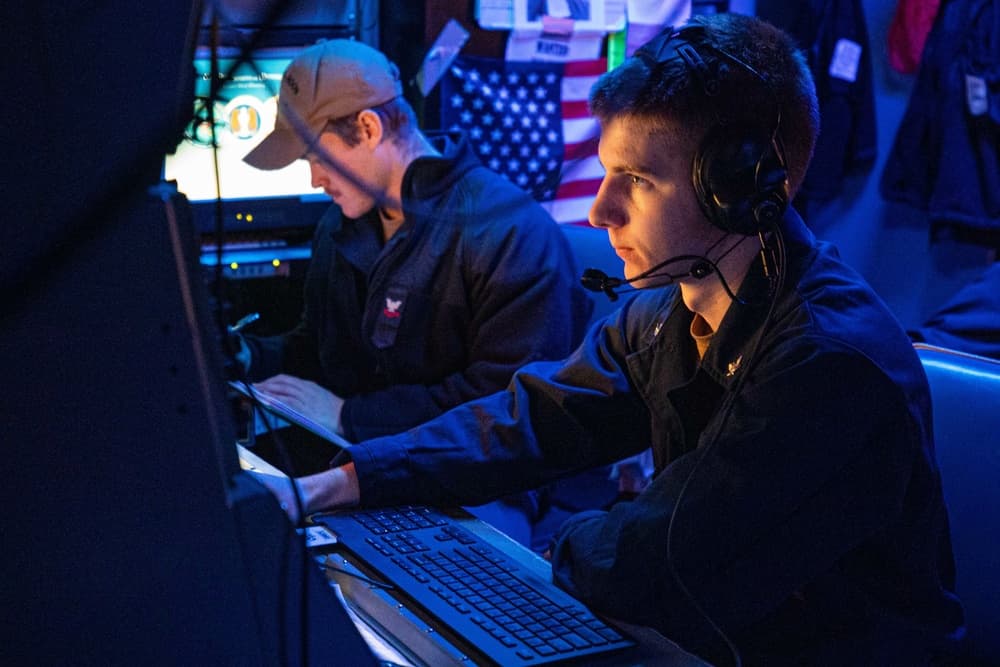
Cryptologic Technician
Parent rating for cryptologic specialties focused on signals intelligence and cybersecurity.
Overall
Quick Stats
Security Clearance
Top Secret / Sensitive Compartmented Information~$15K–$50K civilian sector value
Requires a Single Scope Background Investigation (SSBI), including interviews with references, financial review, and a possible polygraph. The process typically takes 6–12 months and is initiated during your training pipeline.
ASVAB Requirements
Who This Is Best For
Best for intellectually curious individuals who want to enter the intelligence and cryptology field with multiple specialization paths. Top-secret clearance and some of the highest-paying civilian transition paths in the Navy — particularly into NSA, CIA, and defense contractor roles — make this community ideal for analytical minds seeking high-impact careers.
+Pros
- ✓Strong civilian career transition
–Cons
- ✗Long A-school pipeline
Real Opinions
+Positive
“I would recommend CT to anyone considering it. The training is solid and the community takes care of its own.”
“The CT community has some of the best quality of life in the entire Navy. About 99 percent of CT commands are shore commands, so your day-to-day feels more like a civilian job than most other Navy rates.”
“When you get out, the civilian career prospects are incredible. A significant number of former Navy cryptologists make six-figure incomes in cybersecurity, intelligence, and ethical hacking. The security clearance and computer expertise make you a prime candidate.”
–Critical & Mixed
“Like any rate, CT has its downsides. Long hours, time away from family, and Navy bureaucracy are real.”
“The leadership is terrible. Everybody seems to be looking out for themselves and not their sailors. You will deal with people who only care about their own advancement and will throw you under the bus without a second thought.”
“Direct support billets can be demanding and cut heavily into family time. The system you work on is so important to the ship that the job is not only time-intensive but incredibly stressful. Work-life balance is rated only 2.5 out of 5.”
“Constantly being away from family and fearing the worst, along with being stabbed in the back by your chain of command. The constant rotation of personnel makes it hard to continue operations smoothly — just when you get a good team together, people transfer.”
Recruiter vs Reality
What the recruiter says vs. what it's actually like.
🫡 Recruiter says
“The CT rate offers great training and career advancement opportunities!”
💀 Reality
Source: MyNavyRates researchTraining and advancement are available but vary by command and manning. Ask specific questions about sea/shore rotation, typical duty stations, and advancement rates for CT.
🫡 Recruiter says
“CT guarantees a TS/SCI clearance.”
💀 Reality
Source: sailor forumsMost CT sub-ratings do get TS/SCI, but the clearance investigation can disqualify you for financial issues, foreign contacts, or drug history. If denied, you get reclassified.
🫡 Recruiter says
“Cryptologic Technicians do top-secret intelligence work.”
💀 Reality
Source: veteran feedbackCT is an umbrella for several sub-ratings (CTI, CTM, CTN, CTR, CTT). Make sure you know which one you are signing for. Each has very different daily work, from linguistics to maintenance to cyber.
🫡 Recruiter says
“CT is the best intel rating — you'll be doing top-secret work right away.”
💀 Reality
CT covers five very different sub-ratings: CTI, CTR, CTT, CTM, and CWT. Make sure you know exactly which one is on your contract — each has a completely different daily job.
🫡 Recruiter says
“You'll get a TS/SCI clearance guaranteed.”
💀 Reality
The investigation averages 200-250+ days. If you have foreign contacts, financial issues, or past drug use, you can be denied and reclassified. You may sit at Corry Station for months waiting.
🫡 Recruiter says
“CT rates are mostly shore duty — great quality of life.”
💀 Reality
CTI and CWT are shore-heavy, but CTR is roughly 60% sea and CTT is heavily ship-based. CTM is about 50/50. Your specific sub-rating determines your sea/shore flow.
🫡 Recruiter says
“The CT community has great advancement.”
💀 Reality
Advancement varies wildly by sub-rating and paygrade. Some are overmanned at certain levels, which tanks promotion chances. Check the most recent cycle results for the specific CT sub-rating you are considering.
🫡 Recruiter says
“CT training is interesting and high-speed.”
💀 Reality
Schools range from 12 weeks (CTT) to 64+ weeks (CTI language training). Failing out can result in reclassification to an undesignated rate or a completely different job.
🫡 Recruiter says
“A CT clearance is worth six figures on the outside.”
💀 Reality
The clearance is valuable, but it expires after separation if not picked up quickly. Entry-level cleared positions typically pay $55K-$80K, not $120K+. Six-figure jobs require years of experience plus industry certifications.
Training Pipeline — Total ~34 weeks (8 months)
Ship Date Calculator
Enter your MEPS ship date to see when you'll complete each stage.
Promotion SpeedEarn higher pay fasterAverageManning 92% (E-5/E-6)
| Cycle (Year) | Eligible | Selected | Promotion % |
|---|---|---|---|
| E-4252-Spring(2024) | 81 | 38 | 47% |
| E-4252-Fall(2024) | 55 | 62 | 113% |
| E-5252-Spring(2024) | 181 | 15 | 8% |
| E-5252-Fall(2024) | 41 | 13 | 32% |
| E-6252-Spring(2024) | 86 | 14 | 16% |
| E-6252-Fall(2024) | 121 | 7 | 6% |
Bonuses — Click here to see your military pay
Enlistment Bonus
No active bonus for this rate
You May Qualify for a Navy Enlisted Classification (NEC)
Specialties within this rate you can select, some with additional compensation. Each NEC has its own training, bonus potential, and career path.
Primary specialty code for Cryptologic Technician rating
Advanced specialty code for experienced Cryptologic Technician personnel
Potential Civilian Post-Navy Outcomes
Intelligence Analyst
Transferability: 7/10
$55k–$90k
Lifestyle7/10
Ship vs. Shore Split
40% / 60%
Deployment Frequency
Moderate
Physical Demand
low — indoor
Watch Standing
4-section rotation, command-dependent
In a 4-section rotation, the crew is divided into four teams. Each team stands a 6-hour watch shift, then has 18 hours off before their next watch. In port, you stand 24-hour duty roughly every 4 days — meaning you stay aboard the ship overnight on your duty day.
Watch qualifications vary by command and platform. Expect to qualify within 90 days of reporting.
Common Duty Stations
—
Schools + spouse jobs
—
Avg waitlist for on-base
95
100 = national avg
—
Schools + spouse jobs
—
Avg waitlist for on-base
135
100 = national avg
—
Schools + spouse jobs
—
Avg waitlist for on-base
155
100 = national avg