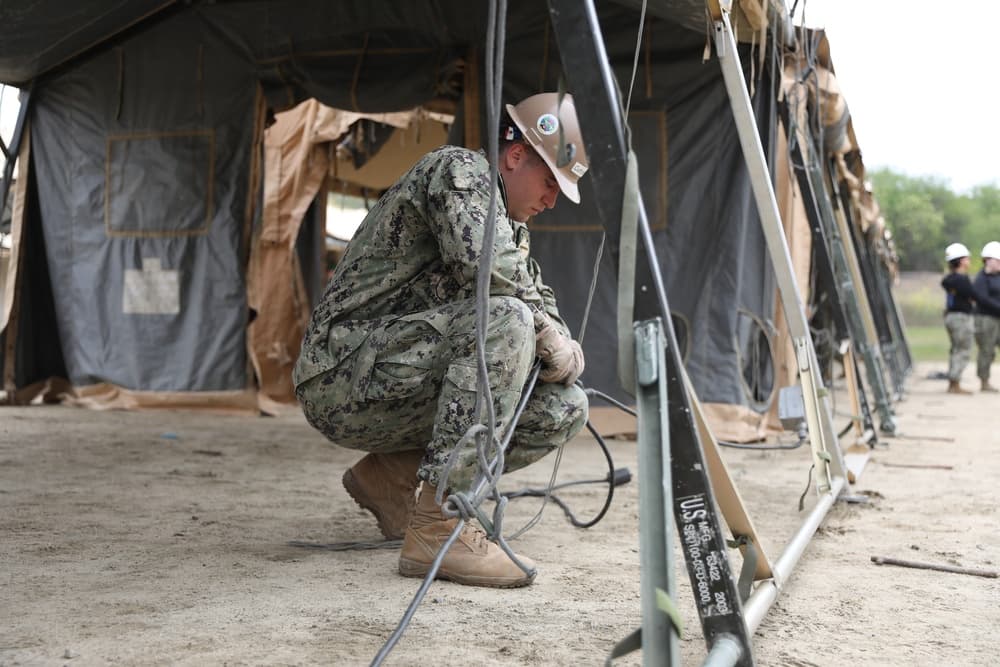
Construction Electrician
Installs and maintains electrical systems at Navy construction sites worldwide.
Overall
Quick Stats
Security Clearance
Secret~$3K–$15K civilian sector value
Requires a National Agency Check with Local Agency Check and Credit Check (NACLC). Processing typically takes 1–3 months and is initiated early in your training pipeline.
ASVAB Requirements
Who This Is Best For
Best for aspiring electricians who want to earn licensure-track experience through real-world construction projects around the globe. Training hours translate directly to civilian apprenticeships and journeyman credentials — one of the most directly transferable Seabee rates.
+Pros
- ✓Strong civilian career transition
–Cons
Real Opinions
+Positive
“CE is one of the best-kept secrets in the Navy. You learn real electrical work and get licensed. Civilian electricians make great money.”
“The Seabee community has a strong sense of pride and identity. We Can Do is not just a motto.”
“Seabees are the best-kept secret in the Navy. Great deployments, real skills, and you actually build stuff.”
–Critical & Mixed
“Advancement can be slow in the construction rates because the community is smaller than fleet rates.”
“Deployments can be to some rough locations. And you are still in the Navy, so expect Navy nonsense on top of the construction work.”
“There are only about 1,000 Construction Electricians in the Navy, which means limited billets and slower advancement compared to fleet electrical rates. In Seabee units you should expect field conditions — tents, temporary power, dust, mud, and long days outside. Getting to CE1 takes about 4.5 years and making Chief takes over 10 years.”
Recruiter vs Reality
What the recruiter says vs. what it's actually like.
🫡 Recruiter says
“Seabees travel the world building things and have great quality of life!”
💀 Reality
Source: MyNavyRates researchQuality of life is generally good but deployments to austere locations (desert, jungle) are common. You will do real construction but also a lot of maintenance and military duties.
🫡 Recruiter says
“CE leads to a journeyman electrician career.”
💀 Reality
Source: sailor forumsCE experience counts toward civilian apprenticeship hours in many states. Combined with the GI Bill for trade school, CE is one of the strongest blue-collar career pipelines in the Navy.
🫡 Recruiter says
“Construction Electricians wire buildings.”
💀 Reality
Source: veteran feedbackCE does electrical work on construction projects, but Seabee deployments involve harsh conditions and basic infrastructure. You are not wiring smart homes; you are running power to remote camps.
🫡 Recruiter says
“You'll become a skilled electrician wiring buildings and learning a valuable trade.”
💀 Reality
A lot of your work is generator maintenance, running temporary power cables to field camps, and troubleshooting 60-year-old base infrastructure. The work skews toward expeditionary power generation, not clean commercial wiring.
🫡 Recruiter says
“You'll install modern electrical systems on overseas projects.”
💀 Reality
Deployed CEs spend a lot of time in extreme heat keeping generators running. When a generator goes down at 2 AM in Djibouti, guess who gets the call. Expeditionary electrical work means jury-rigging solutions with whatever is available.
🫡 Recruiter says
“It's an electrician job — you'll be safe in the rear with the gear.”
💀 Reality
CEs are Seabees with full combat readiness requirements including M4s, M240Bs, and .50 cal. Seabees deploy to contested areas and build near the front lines. The "safe trade job" framing misses the combat reality.
🫡 Recruiter says
“Construction Electricians advance well because it's a technical rate.”
💀 Reality
CE advancement is subject to the same Seabee community bottleneck. Small community means small quotas. You can be the most proficient electrician in your battalion and still not promote.
🫡 Recruiter says
“You'll leave the Navy as a licensed electrician ready for a civilian career.”
💀 Reality
The Navy does not give you a civilian electrician's license. Each state has its own requirements, and most require thousands of supervised hours that Navy time may not count toward.
🫡 Recruiter says
“As a CE, you'll focus on your electrical specialty every day.”
💀 Reality
You're a Seabee first and an electrician second. That means convoy operations, perimeter security, weapons quals, and field exercises that have nothing to do with wiring.
🫡 Recruiter says
“You'll be stationed at interesting places around the world.”
💀 Reality
Your homeport is Gulfport or Port Hueneme. Deployments go to places like Guam, Djibouti, or Rota — which sound exotic until you realize you're living in a camp working 12-hour days with no liberty.
Training Pipeline — Total ~20 weeks (5 months)
Ship Date Calculator
Enter your MEPS ship date to see when you'll complete each stage.
Promotion SpeedEarn higher pay fasterSlowManning 85% (E-4/E-5)
| Cycle (Year) | Eligible | Selected | Promotion % |
|---|---|---|---|
| E-4252-Spring(2024) | 221 | 35 | 16% |
| E-4252-Fall(2024) | 92 | 73 | 79% |
| E-5252-Spring(2024) | 188 | 26 | 14% |
| E-5252-Fall(2024) | 143 | 63 | 44% |
| E-6252-Spring(2024) | 32 | 10 | 31% |
| E-6252-Fall(2024) | 138 | 35 | 25% |
Bonuses — Click here to see your military pay
Enlistment Bonus
No active bonus for this rate
You May Qualify for a Navy Enlisted Classification (NEC)
Specialties within this rate you can select, some with additional compensation. Each NEC has its own training, bonus potential, and career path.
Primary specialty code for Construction Electrician rating
Advanced specialty code for experienced Construction Electrician personnel
Potential Civilian Post-Navy Outcomes
Construction Electrician
Transferability: 8/10
$48k–$78k
Lifestyle7/10
Ship vs. Shore Split
20% / 80%
Deployment Frequency
Moderate
Physical Demand
medium — outdoor
Watch Standing
Standard workday in garrison, rotating security watch deployed
Watch standing is a 24-hour duty rotation where sailors take turns manning critical positions aboard the ship or at their command. The rotation determines how frequently you stand watch and how much rest time you get between shifts.
Watch qualifications vary by command and platform. Expect to qualify within 90 days of reporting.
Common Duty Stations
—
Schools + spouse jobs
—
Avg waitlist for on-base
155
100 = national avg
—
Schools + spouse jobs
—
Avg waitlist for on-base
125
100 = national avg
—
Schools + spouse jobs
—
Avg waitlist for on-base
80
100 = national avg