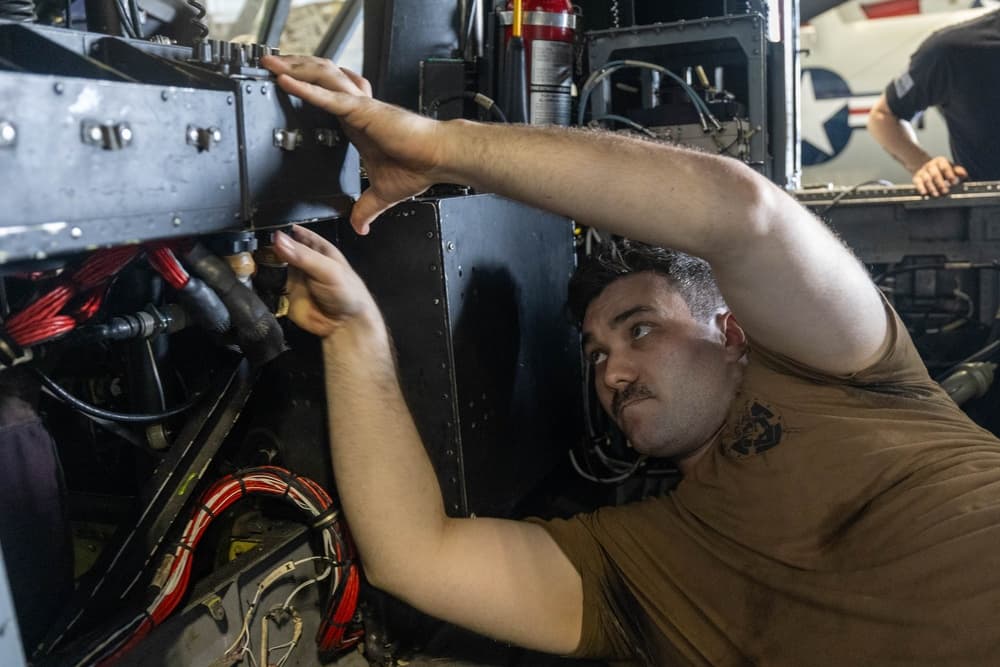
Aviation Electronics Technician
Maintains and repairs aviation electronics and avionics systems.
Overall
Quick Stats
Security Clearance
Secret~$3K–$15K civilian sector value
Requires a National Agency Check with Local Agency Check and Credit Check (NACLC). Processing typically takes 1–3 months and is initiated early in your training pipeline.
ASVAB Requirements
Who This Is Best For
Best for strong analytical thinkers who enjoy working with sophisticated electronics and want some of the best civilian career prospects in the Navy. Defense contractor and IT industry jobs paying six figures actively seek former ATs. Ideal for someone who wants intellectual challenge with strong post-Navy earning potential.
+Pros
- ✓Strong civilian career transition
–Cons
- ✗Long A-school pipeline
Real Opinions
+Positive
“The Navy taught me discipline, technical skills, and how to work under pressure. I feel fully prepared for great opportunities ahead.”
“I would recommend AT to anyone considering it. The training is solid and the community takes care of its own.”
“AT is one of the best-kept secrets in naval aviation. You work on avionics systems — radar, communications, navigation electronics — and the skills transfer directly to civilian avionics technician jobs at airlines and defense contractors. The troubleshooting skills you develop are world-class. CompTIA and avionics certifications come easy after AT training.”
–Critical & Mixed
“The constant inspection and deployment cycle can easily lead to burnout especially if you have a family.”
“Management is a hit or miss. Can either have a really good or really bad experience dependent on your duty station and chain of command.”
“Like any rate, AT has its downsides. Long hours, time away from family, and Navy bureaucracy are real.”
Recruiter vs Reality
What the recruiter says vs. what it's actually like.
🫡 Recruiter says
“The AT rate offers great training and career advancement opportunities!”
💀 Reality
Source: MyNavyRates researchTraining and advancement are available but vary by command and manning. Ask specific questions about sea/shore rotation, typical duty stations, and advancement rates for AT.
🫡 Recruiter says
“AT is the most technical aviation rate.”
💀 Reality
Source: sailor forumsAT and AE both do electronics work. AT focuses on mission systems while AE focuses on airframe electrical. Both are valuable but neither is working on the newest technology daily.
🫡 Recruiter says
“Aviation Electronics Techs work on cutting-edge systems.”
💀 Reality
Source: veteran feedbackAT maintains radar, communication, and navigation electronics on aircraft. The work is technical but involves a lot of bench-level troubleshooting using TO manuals and test equipment.
🫡 Recruiter says
“You'll work on the most advanced electronic systems in the world — radar, communications, electronic warfare.”
💀 Reality
What you work on depends on whether you go O-level or I-level. O-level ATs troubleshoot and swap components on the flight line. I-level ATs repair components down to the circuit card level using test benches like CASS. They are very different jobs under the same rate.
🫡 Recruiter says
“AT is one of the best rates for civilian career transfer — electronics technicians are in demand everywhere.”
💀 Reality
This is genuinely true and arguably undersold. Former ATs earn excellent civilian salaries in defense contracting, avionics repair, telecom, and IT. But you need to actively pursue civilian certifications like CompTIA, FCC licenses, or avionics credentials while still in.
🫡 Recruiter says
“A-school is 21 weeks of advanced electronics training — you'll be a trained technician.”
💀 Reality
A-school is genuinely rigorous. But the gap between A-school knowledge and fleet competency is significant. At your first command you will feel lost. Becoming a competent AT takes a year or more of OJT and PQS qualifications.
🫡 Recruiter says
“You'll troubleshoot and repair cutting-edge systems every day.”
💀 Reality
I-level ATs spend long hours running components through CASS test benches — lots of waiting for automated tests then interpreting results. O-level ATs spend more time on scheduled maintenance and cannon plug checks than on actual troubleshooting.
🫡 Recruiter says
“You'll get assigned to a fleet squadron and work on aircraft right away.”
💀 Reality
You might get a fleet squadron, or you might get an FRC for I-level work. Some ATs spend their entire first tour at a bench and never touch an aircraft. Both paths have value, but the recruiter always pitches the flight line image.
🫡 Recruiter says
“AT is a great rate with strong advancement and good quality of life.”
💀 Reality
AT is one of the larger aviation rates, which means more advancement quotas but also more competition. Quality of life depends heavily on your command — a shore-based FRC is dramatically different from a deploying fleet squadron.
Training Pipeline — Total ~34 weeks (8 months)
Ship Date Calculator
Enter your MEPS ship date to see when you'll complete each stage.
Promotion SpeedEarn higher pay fasterAverageManning 85% (E-4/E-5)
| Cycle (Year) | Eligible | Selected | Promotion % |
|---|---|---|---|
| E-4252-Spring(2024) | 78 | 72 | 92% |
| E-4252-Fall(2024) | 244 | 84 | 34% |
| E-5252-Spring(2024) | 112 | 59 | 53% |
| E-5252-Fall(2024) | 116 | 56 | 48% |
| E-6252-Spring(2024) | 77 | 8 | 10% |
| E-6252-Fall(2024) | 86 | 14 | 16% |
Bonuses — Click here to see your military pay
Enlistment Bonus
No active bonus for this rate
You May Qualify for a Navy Enlisted Classification (NEC)
Specialties within this rate you can select, some with additional compensation. Each NEC has its own training, bonus potential, and career path.
Primary specialty code for Aviation Electronics Technician rating
Advanced specialty code for experienced Aviation Electronics Technician personnel
Potential Civilian Post-Navy Outcomes
Avionics Technician
Transferability: 8/10
$50k–$80k
Free Certifications & Credentials
Certifications and licenses the Navy will pay for free through Navy COOL and on-the-job training.
FAA Airframe & Powerplant (A&P)
FAA
CompTIA A+
CompTIA
Lifestyle6/10
Ship vs. Shore Split
50% / 50%
Deployment Frequency
Moderate
Physical Demand
medium — indoor
Watch Standing
Flight schedule dependent, rotating duty days
Watch standing is a 24-hour duty rotation where sailors take turns manning critical positions aboard the ship or at their command. The rotation determines how frequently you stand watch and how much rest time you get between shifts.
Watch qualifications vary by command and platform. Expect to qualify within 90 days of reporting.
Common Duty Stations
—
Schools + spouse jobs
—
Avg waitlist for on-base
95
100 = national avg
—
Schools + spouse jobs
—
Avg waitlist for on-base
135
100 = national avg
—
Schools + spouse jobs
—
Avg waitlist for on-base
92
100 = national avg