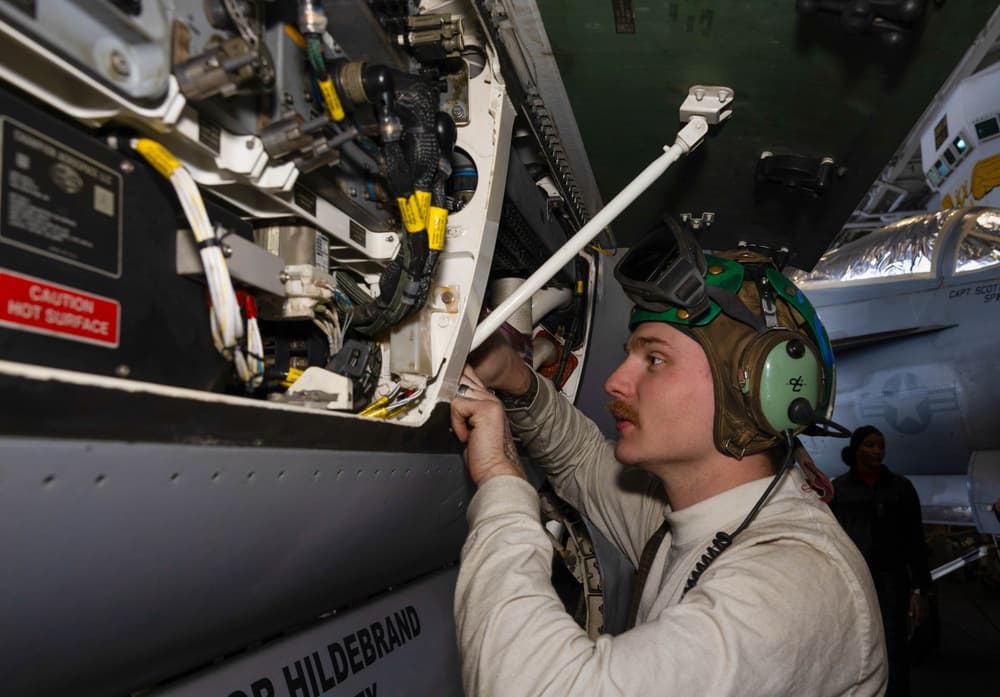
Aviation Electrician's Mate
Aviation Electricians Mates maintain electrical and instrument systems on Navy aircraft. They troubleshoot avionics, wiring, and flight instrument systems.
Overall
Quick Stats
Security Clearance
None
This rate does not require a security clearance.
ASVAB Requirements
Who This Is Best For
Best for analytically minded individuals with an aptitude for electronics who enjoy solving complex diagnostic puzzles. If you want deep technical training that opens doors to avionics, aerospace electrical, and defense contracting careers, this rate provides strong post-Navy earning potential with a desk-and-hangar lifestyle balance.
+Pros
- ✓Strong civilian career transition
–Cons
Real Opinions
+Positive
“AE is one of the better aviation rates. You learn real electrical troubleshooting skills that civilian employers actually want.”
“Advancement is decent compared to other aviation rates. Study hard and you can make E-5 pretty quick.”
“I would recommend AE to anyone considering it. The training is solid and the community takes care of its own.”
–Critical & Mixed
“Work-life balance is terrible on deployment. You are always on call if something breaks on an aircraft.”
“Like any rate, AE has its downsides. Long hours, time away from family, and Navy bureaucracy are real.”
“AE work is technically interesting — you're troubleshooting complex electrical systems on aircraft. But the advancement bottleneck from E-5 to E-6 is brutal. The community is overmanned at mid-grades, which means excellent sailors get passed over for years. Shore duty billets are limited and hard to get as a junior AE.”
Recruiter vs Reality
What the recruiter says vs. what it's actually like.
🫡 Recruiter says
“The AE rate offers great training and career advancement opportunities!”
💀 Reality
Source: MyNavyRates researchTraining and advancement are available but vary by command and manning. Ask specific questions about sea/shore rotation, typical duty stations, and advancement rates for AE.
🫡 Recruiter says
“AE sets you up for civilian aviation careers.”
💀 Reality
Source: sailor forumsAE skills transfer but you need the FAA A&P license for most civilian aviation jobs. Start working on it while you are still in through Navy COOL.
🫡 Recruiter says
“Aviation Electricians work on advanced avionics.”
💀 Reality
Source: veteran feedbackAE work involves troubleshooting electrical systems using wiring diagrams and multimeters. It is methodical diagnostic work, not glamorous top-gun technology.
🫡 Recruiter says
“You'll work on advanced avionics and electrical systems — it's like being an electrician for fighter jets.”
💀 Reality
Much of your day-to-day is wire chasing — tracing faults through wiring diagrams with a multimeter, crawling into tight aircraft compartments to inspect connector pins, and replacing corroded contacts one at a time.
🫡 Recruiter says
“A-school is only 13 weeks and then you're qualified to work on aircraft electrical systems.”
💀 Reality
A-school gives you theory and basics, but you arrive at your first command knowing almost nothing about your specific aircraft. Expect 6-12 months of OJT and PQS sign-offs before you are trusted to troubleshoot independently.
🫡 Recruiter says
“Your skills transfer directly to civilian electrical and avionics careers.”
💀 Reality
AE skills do transfer, but civilian employers want specific certifications — FCC licenses, A&P certificates, or avionics-specific credentials. Military experience alone without civilian certs makes you competitive but not a guaranteed hire.
🫡 Recruiter says
“You'll troubleshoot cutting-edge electronics on the Navy's newest platforms.”
💀 Reality
A huge percentage of your work is scheduled maintenance — removing and reinstalling components, performing continuity checks, and documenting everything in NALCOMIS. Actual fault isolation might be 20% of your workload. The other 80% is procedures and paperwork.
🫡 Recruiter says
“You can expect about 60% of your career at sea — it's balanced between sea and shore.”
💀 Reality
60% sea duty means the majority of your career is on deployment or on a ship in port. During deployment, you work 12-14 hour days minimum. "Balance" in the Navy does not mean what it means in the civilian world.
🫡 Recruiter says
“AE is a great rate for people who like solving problems and working with their hands.”
💀 Reality
Intermittent electrical faults that only appear in flight, connectors with 200+ pins where one is barely out of spec, wiring harnesses buried behind panels that take two hours to access — this is the reality. Patience and frustration tolerance matter more than raw intelligence.
Training Pipeline — Total ~20 weeks (5 months)
Ship Date Calculator
Enter your MEPS ship date to see when you'll complete each stage.
Promotion SpeedEarn higher pay fasterSlowManning 88% (balanced)
| Cycle (Year) | Eligible | Selected | Promotion % |
|---|---|---|---|
| E-4252-Spring(2024) | 141 | 18 | 13% |
| E-4252-Fall(2024) | 111 | 19 | 17% |
| E-5252-Spring(2024) | 183 | 52 | 28% |
| E-5252-Fall(2024) | 128 | 15 | 12% |
| E-6252-Spring(2024) | 88 | 20 | 23% |
| E-6252-Fall(2024) | 120 | 41 | 34% |
Bonuses — Click here to see your military pay
Enlistment Bonus
No active bonus for this rate
You May Qualify for a Navy Enlisted Classification (NEC)
Specialties within this rate you can select, some with additional compensation. Each NEC has its own training, bonus potential, and career path.
Primary specialty code for Aviation Electrician's Mate rating
Advanced specialty code for experienced Aviation Electrician's Mate personnel
Potential Civilian Post-Navy Outcomes
Avionics Technician
Transferability: 7.8/10
$55k–$92k
Free Certifications & Credentials
Certifications and licenses the Navy will pay for free through Navy COOL and on-the-job training.
FAA Airframe & Powerplant (A&P)
FAA
Certified Electronics Technician
ETA International
Lifestyle6/10
Ship vs. Shore Split
50% / 50%
Deployment Frequency
Moderate
Physical Demand
medium — mixed
Watch Standing
Flight schedule dependent, rotating duty days
Watch standing is a 24-hour duty rotation where sailors take turns manning critical positions aboard the ship or at their command. The rotation determines how frequently you stand watch and how much rest time you get between shifts.
Watch qualifications vary by command and platform. Expect to qualify within 90 days of reporting.
Common Duty Stations
—
Schools + spouse jobs
—
Avg waitlist for on-base
95
100 = national avg
—
Schools + spouse jobs
—
Avg waitlist for on-base
135
100 = national avg
—
Schools + spouse jobs
—
Avg waitlist for on-base
92
100 = national avg